Shipping Renovate Bot to a FluxCD GitOps Homelab

The Goal
One of the things I wanted from this homelab from the start was automatic dependency updates. Not clicking through GitHub PRs manually, not noticing weeks later that a container image is three major versions behind. Renovate Bot watches your repo, finds stale image tags and Helm chart versions, and opens PRs to fix them — automatically, on a schedule.
In a GitOps cluster, that means deploying Renovate as a Kubernetes CronJob, encrypting the GitHub PAT it needs, and wiring the whole thing through Flux so it’s committed, auditable, and reproducible. Here’s exactly how I did it — mistakes included.
The Architecture
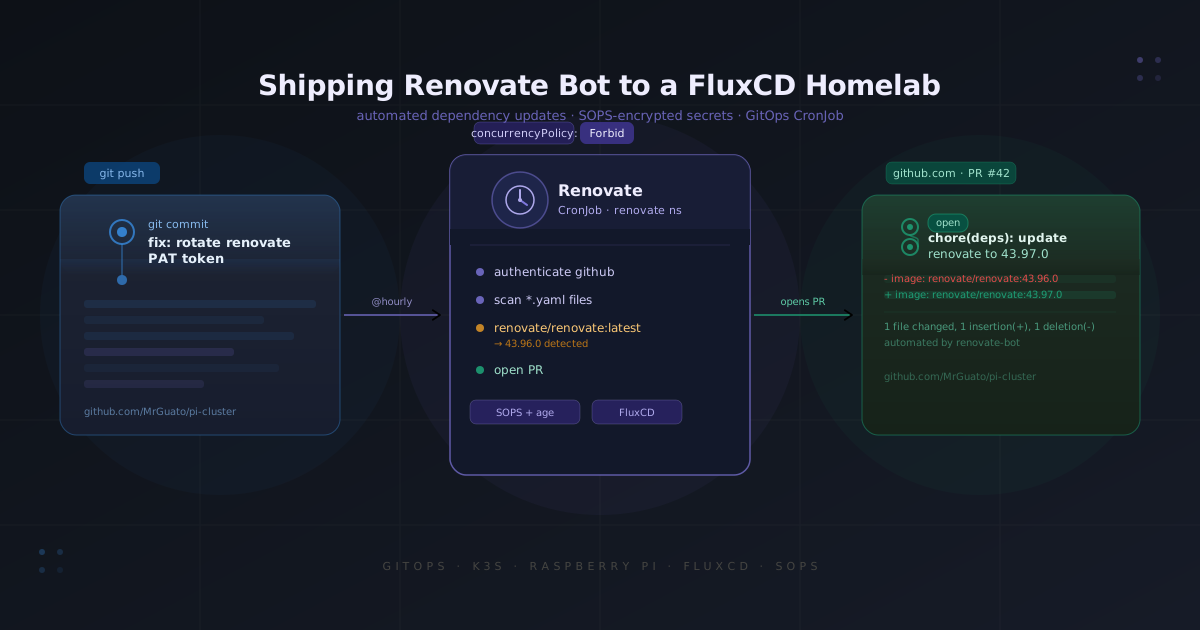
Renovate runs as a CronJob in a dedicated renovate namespace. Every hour, Kubernetes spins up a pod, Renovate authenticates to GitHub using a Personal Access Token stored as a SOPS-encrypted Secret, scans the repo, and exits. No long-running daemon, no persistent storage needed.
The config lives entirely in the GitOps tree:
infrastructure/
└── controllers/
    ├── base/
    │   └── renovate/
    │       ├── namespace.yaml
    │       ├── cronjob.yaml
    │       ├── configmap.yaml
    │       ├── renovate-container-env.yaml   ← SOPS-encrypted PAT
    │       └── kustomization.yaml
    └── staging/
        ├── kustomization.yaml                ← wires renovate into Flux
        └── renovate/
            └── kustomization.yaml            ← points at base
And a renovate.json at the repo root tells Renovate what to scan:
{
  "$schema": "https://docs.renovatebot.com/renovate-schema.json",
  "kubernetes": {
    "fileMatch": ["\\.yaml$"]
  }
}
Step 1: The Namespace
# infrastructure/controllers/base/renovate/namespace.yaml
apiVersion: v1
kind: Namespace
metadata:
  name: renovate
Simple. Every app gets its own namespace.
Step 2: The ConfigMap
Non-sensitive config goes in a ConfigMap — platform, git author, autodiscover off (we’re explicitly targeting one repo):
# infrastructure/controllers/base/renovate/configmap.yaml
apiVersion: v1
kind: ConfigMap
metadata:
  name: renovate-configmap
  namespace: renovate
data:
  RENOVATE_AUTODISCOVER: "false"
  RENOVATE_GIT_AUTHOR: "Renovate Bot <bot@renovateapp.com>"
  RENOVATE_PLATFORM: "github"
Step 3: The Secret
The GitHub PAT goes into a SOPS-encrypted Secret. The workflow:
# 1. Render the manifest without touching the cluster
kubectl create secret generic renovate-container-env \
  --from-literal=RENOVATE_TOKEN=<your-pat> \
  --namespace=renovate \
  --dry-run=client \
  -o yaml > infrastructure/controllers/base/renovate/renovate-container-env.yaml

# 2. Encrypt in place — only the data fields, metadata stays readable
export AGE_PUBLIC=<your-age-public-key>
sops --age=$AGE_PUBLIC \
  --encrypt \
  --encrypted-regex '^(data|stringData)$' \
  --config clusters/staging/.sops.yaml \
  --in-place infrastructure/controllers/base/renovate/renovate-container-env.yaml
The --config clusters/staging/.sops.yaml flag is not optional. My .sops.yaml lives inside clusters/staging/, not at the repo root. Without the explicit config path, SOPS can’t find the age recipient and fails with a cryptic “config file not found” error.
Step 4: The CronJob
# infrastructure/controllers/base/renovate/cronjob.yaml
apiVersion: batch/v1
kind: CronJob
metadata:
  name: renovate
  namespace: renovate
spec:
  schedule: "@hourly"
  concurrencyPolicy: Forbid
  jobTemplate:
    spec:
      template:
        spec:
          containers:
            - name: renovate
              image: renovate/renovate:latest
              args:
                - MrGuato/pi-cluster
              envFrom:
                - secretRef:
                    name: renovate-container-env
                - configMapRef:
                    name: renovate-configmap
          restartPolicy: Never
concurrencyPolicy: Forbid means if a run is still going when the next one fires, the new one is skipped. Sensible for a homelab repo where scans finish in seconds.
Step 5: Kustomize Wiring
Every layer needs an explicit kustomization.yaml. Kustomize never auto-discovers subdirectories — if it’s not in resources:, it doesn’t exist.
Base:
# infrastructure/controllers/base/renovate/kustomization.yaml
apiVersion: kustomize.config.k8s.io/v1beta1
kind: Kustomization
resources:
  - namespace.yaml
  - renovate-container-env.yaml
  - configmap.yaml
  - cronjob.yaml
Staging overlay (just points at base, no patches needed):
# infrastructure/controllers/staging/renovate/kustomization.yaml
apiVersion: kustomize.config.k8s.io/v1beta1
kind: Kustomization
namespace: renovate
resources:
  - ../../base/renovate
Staging parent (wires the renovate subdirectory into Flux’s view):
# infrastructure/controllers/staging/kustomization.yaml
apiVersion: kustomize.config.k8s.io/v1beta1
kind: Kustomization
resources:
  - renovate
What Actually Broke (Everything, In Order)
This took several rounds of debugging. Here’s the honest account.
Bug 1: resource: instead of resources:
Both kustomization.yaml files had resource: (singular) instead of resources: (plural). Kustomize silently ignores unknown keys — it doesn’t error, it just processes an empty resource list and creates nothing. The namespace never appeared, no error was shown, Flux reported Ready: True against thin air.
The fix is obvious once you see it. The lesson is to always verify with kubectl get ns after reconciliation, not just flux get kustomizations.
Bug 2: secrets.yaml ghost entry
The base kustomization.yaml listed both secrets.yaml and renovate-container-env.yaml. The file was always named renovate-container-env.yaml — secrets.yaml was a leftover from an earlier draft. Kustomize tried to find it, failed, and the full error surfaced:
accumulating resources: accumulation err='accumulating resources from 'secrets.yaml':
open /tmp/.../infrastructure/controllers/base/renovate/secrets.yaml:
no such file or directory'
Removed the ghost entry, problem gone.
Bug 3: The staging parent kustomization didn’t exist
The Flux Kustomization CR pointed at infrastructure/controllers/staging. That directory had a renovate/ subdirectory, but no kustomization.yaml at the staging/ level itself. Flux had nothing to read. The subdirectory was simply invisible.
Created infrastructure/controllers/staging/kustomization.yaml listing - renovate under resources: and the chain was complete.
Bug 4: Git rebase collision
35 commits had accumulated on remote while local work was in progress. A git pull --rebase caused a conflict on readme.md because both sides had modified it. Resolved by taking the remote version (git checkout --theirs readme.md), marking resolved, and continuing the rebase.
Confirming It Works
After all fixes were committed and pushed:
flux reconcile source git flux-system
kubectl get ns
# renovate   Active   ...

kubectl get cronjob -n renovate
# NAME       SCHEDULE   SUSPEND   ACTIVE   LAST SCHEDULE
# renovate   @hourly    False     0        <none>

# Trigger a manual run
kubectl create job renovate-manual --from=cronjob/renovate -n renovate

# Watch the logs
kubectl logs -n renovate -l job-name=renovate-manual -f
# INFO: Renovate started
# INFO: Repository started
# ...
# INFO: Branch renovation complete
Renovate authenticated, scanned the repo, and finished cleanly. The first automated PRs will open on the next hourly tick.
Key Takeaways
resources: is plural. Always. Kustomize won’t tell you if you get it wrong.
Every directory in the chain needs its own kustomization.yaml. If staging/ doesn’t have one listing its subdirectories, those subdirectories don’t exist from Flux’s perspective.
--config is required when .sops.yaml isn’t at the repo root. My cluster keeps it at clusters/staging/.sops.yaml. Forgetting this flag produces a confusing error that looks like a key problem but is actually a path problem.
flux get kustomizations is not the full picture. Always verify what actually landed in the cluster with kubectl get ns and kubectl get all -n <namespace>.
Repo
All manifests for this setup live at github.com/MrGuato/pi-cluster.
Built with ❤️ by Jonathan — If it is not in Git, it does not exist.